Pending Application - Taftsville Project, Vermont
| Project Name | Taftsville |
| LIHI Certificate No. |
n/a |
| LIHI Certificate Term |
n/a |
| Owner | Green Mountain Power |
| State | Vermont |
| Location | River Mile 11.3 on the Ottauquechee River |
| Installed Capacity | 0.5 MW |
| Average Annual Generation | 1,038 MWh |
| Facility Type | Run-of-river |
| FERC No. | P-2490 license issued in 1994, awaiting new license |
The Taftsville project is a 0.5-megawatt (MW) Taftsville Project located on the Ottauquechee River in the Hamlet of Taftsville, town of Woodstock, in Windsor County, Vermont. The Ottauquechee River has a mainstem length of 38 miles and drains an area of 223 square miles. From Killington Peak the river drops almost 3900 feet in elevation down to the Connecticut River in Hartland. There are no upstream dams on the river but there are several downstream dams including Downer’s Mill (LIHI #122) and the North Hartland USACE flood control dam.
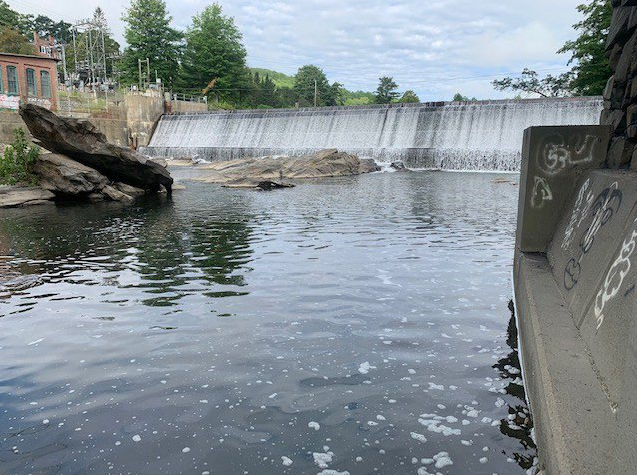
The project consists of a 220-foot-long, 16-foot-high concrete gravity dam which was originally constructed in 1794 and rebuilt for hydropower in 1909. The dam has a 194-foot-long spillway section that has a crest elevation of 637.12 feet National Geodetic Vertical Datum of 1929 (NGVD 29) and is topped with 18-inch-high wooden flashboards. The dam creates a 0.9-mile-long impoundment with a surface area of approximately 20.5 acres at the normal water surface elevation of 638.6 feet NGVD 29. The dam also creates a bypassed reach approximately 290 feet long. An integral intake structure contains a motorized headgate faced with a 15-foot-long by 13-foot-deep trashrack system with 3-inch clear bar spacing. A concrete penstock, 11 feet high, 6 feet 8 inches wide, and 36 feet long conveys water from the dam to the powerhouse which is contains the single 0.5-MW vertical Kaplan turbine. Two substations are located within the Project boundary as well as three approximately 75-foot-long, 46-kilovolt (kV) transmission lines, and (8) appurtenant equipment and facilities.
The project operates in a run-of-river mode with stable impoundment level and when refilling the impoundment, 90 percent of inflow is passed while the remaining 10 percent is used to refill the impoundment. A year-round minimum flow of 45 cfs is provided uniformly over the dam crest to enhance aesthetics and support aquatic habitat, based on instream flow studies conducted for FERC relicensing.
The Ottauquechee River in the Project area is classified as Class B(2) cold water fish habitat, managed to support the designated uses of aquatic biota, wildlife, and aquatic habitat; aesthetics; public water supply; irrigation of crops and other agricultural uses; swimming and other primary contact recreation; and boating, fishing, and other recreational uses. Water quality studies indicated that the project is not the cause of impairments from phosphorus and e coli in the impoundment. Additional water sampling will be conducted after the new FERC license is issued to confirm the that project does not adversely affect water quality.
There are no migratory fish species in the project area due to downstream barriers on the Ottauquechee River and the mainstem Connecticut River. While the dam was built in the late 1700’s, the Turner Falls Dam downstream on the Connecticut River in Massachusetts was also built at that time, resulting in a major barrier to passage up into the Connecticut River watershed. Resident fish species include both cold water and warm water species. While some turbine entrainment could occur for juvenile resident species the effect is expected to be minimal, and the bypass reach minimum flow provides a safe route of passage for downstream migrating fish.
The project boundary encompasses 20.76 acres with 19.21 of those acres being the impoundment. Lands around the project consist of forest, agriculture and the minimally developed hamlet of Taftsville. There are no lands of ecological significance and run-of-river operations help to keep shorelines stable.
Threatened or endangered species that may be present include northern-long eared bat, eastern pearlshell mussel (state listed) downstream of the project, and obedient plant (aka false dragon-head) which was observed at the project. Tree cutting is restricted between April 1 and October 31 to protect bat habitat, and routine vegetation management within the small project footprint is unlikely to adversely affect plant or other species.
The Taftsville dam, powerhouse, and substations are documented in a National Register of Historic Places registration form as contributing structures to the Taftsville Historic District. No archaeological sites have been documented at the project although shoreline erosion monitoring and annual reporting occur, and consultation with the state historic preservation office is required if previously undiscovered cultural or historic resources are found.
The project provides public access on both sides of the river, including a parking and picnic area, interpretive sign, viewing platform, and bank fishing area, and a canoe portage. Access is provided free of charge.
Certification History
October 7, 2026 The Low Impact Hydropower Institute has received a complete application for Low Impact Certification of the Taftsville Hydroelectric Project. LIHI is seeking public comment on this application. Specifically, we are interested in knowing whether you think the Project meets the LIHI Low Impact Certification Criteria. Please review the program and criteria in LIHI’s Handbook Revision 2.06 and then review the Project’s application materials below.
Comments that are directly tied to specific LIHI criteria (flows, water quality, fish passage, etc.) will be most helpful, but all comments will be considered. Comments may be submitted to the Institute by e-mail at comments@lowimpacthydro.org with “Taftsville Project Comments” in the subject line, or by mail addressed to the Low Impact Hydropower Institute, 68 Harrison Ave Ste 605, PMB 113938 Boston, Massachusetts 02111-1929. Comments must be received on or before 5 pm Eastern time on December 6, 2026 to be considered. All comments will be posted to the web site and the applicant will have an opportunity to respond. Any response will also be posted.