
Pending Application - Mt. Ida Project, New York
| Project Name | Mt. Ida |
| LIHI Certificate No. |
n/a |
| LIHI Certificate Term |
n/a |
| Owner | Mt Ida Hydro LLC (a subsidiary of Relevate Power LLC) |
| State | New York |
| Location | River Mile 1.2 on Poestenkill Creek, Troy NY |
| Installed Capacity | 2.92 MW |
| Average Annual Generation | 8,266 MWh |
| Facility Type | Run-of-river |
| FERC No. | P-5465 exempt issued October 20, 1982 |
The Mt. Ida Project is located in the City of Troy, NY in Rensselaer County, and is the first dam on the 26.2-mile-long Poestenkill Creek (or Poesten Kill) above its confluence with the Hudson River. The project sits at the top of Poestenskill Gorge (Mt. Ida Falls) which consists of five distinct drops, totaling about 120 feet in height overall, though no single drop is more than 32 feet in height. From its headwaters at Dyken Pond, the creek drops 1,600 feet.
A partially removed non-hydro dam (Mt. Ida Lake) owned by the City of Troy is located about 0.2 miles upstream, and the small 30-kW Poestenkill Hydroelectric Project (FERC No. 5597) is located farther upstream.
The dam was originally constructed in 1840 and the current hydroelectric project was developed in 1982 at the site of former small mills and hydro facilities that were interconnected by a single intake and penstock. Some of this pre-existing infrastructure was retained when the project was redeveloped.
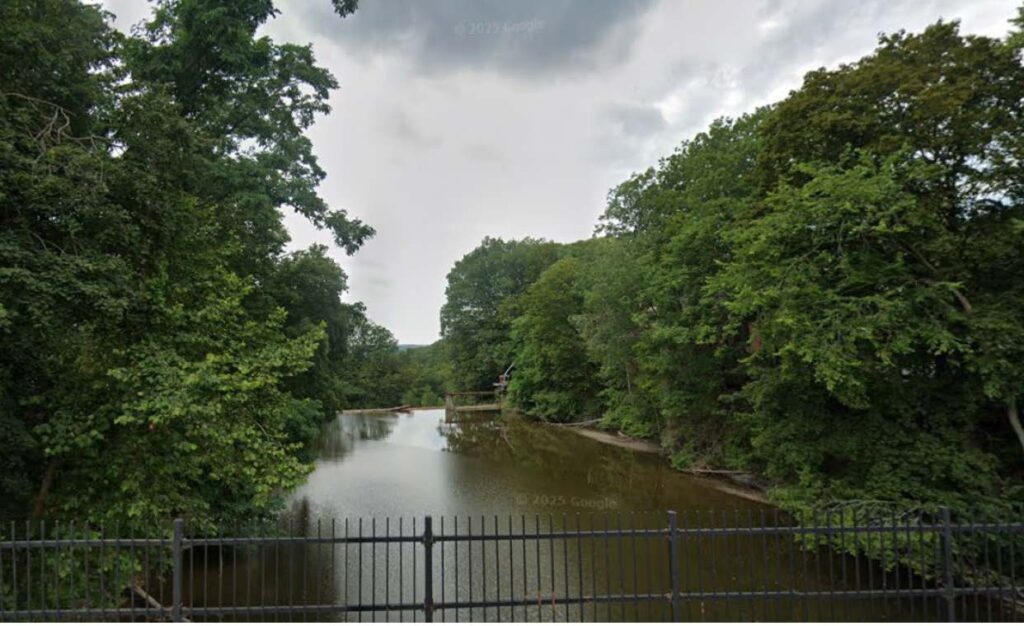
The project consists of the rehabilitated timber crib dam, 150 feet long and varying in height from 4.5 feet to 13 feet with an average height of 10.5 feet. The dam creates a small impoundment about 1,000 feet long which backwaters up to the former Mt. Ida Lake dam. The impoundment has a surface area of 1.4 acres, and 12 acre-feet of storage. The intake structure includes the pre-existing rehabilitated 525-foot-long rock tunnel with a steel liner and a gatehouse. A 60-inch diameter steel penstock conveys water from the tunnel approximately 775 feet to the powerhouse located on the north side of the creek. The powerhouse is in a former mill building and houses two horizontal Francis turbines with a generating capacity of 1,460 kW each, or 2.92 MW total. The Project includes an approximately 450-foot-long transmission line and other appurtenant facilities.
The project operates in an instantaneous run-of-river mode monitored by a PLC and SCADA system to maintain stable impoundment levels and minimize fluctuations. a 5-cfs minimum flow into the bypassed reach is provided to maintain aesthetic views of Poestenkill Creek Gorge at Poestenkill Creek Gorge Park, located on the southern shoreline of the bypass reach.
Waters within the project reach are designated as Class C, suitable for fish, shellfish, and wildlife propagation and survival. The water quality is to be suitable for primary and secondary contact recreation, although other factors may limit the use for these purposes. There are no state-listed impaired waters in the creek and sampling conducted in 2017-2019 indicated moderate temperatura and good dissolved oxygen levels.
There are no migratory fish present at the project due to the the steep gorge and falls in the bypassed reach. American eels are present in the Hudson River, the lower reach below the gorge, and in small numbers above the gorge. Resident species including brown bullhead, rock bass, yellow perch, white sucker, bluegill, spottail shiner, pumpkinseed, largemouth bass, common shiner, and long nose dace are present in the impoundment, and the state stocks brown trout there as well. The project intake has 1.5-inch spaced trash racks and an approach velocity of 1.68 feet/second.
Project lands consist of about 1.4 acres of the impoundment, approximately 1.9 acres of the bypassed reach, and less than 1 acre of land. There are no lands of ecological significance, and surrounding lands are highly developed into the City of Troy although there are managed forest lands and non-developed areas along the gorge and upstream of the dam. There are no federal or state-listed threatened or endangered species in the immediate project vicinity.
Poesten Kill Gorge Historic District, which includes the project structures and several former mill buildings (only some of which remain), is listed on the National Register of Historic Places. There are no known or identified traditional cultural properties within the project area.
There is no formal or informal recreation or public access at the project. The impoundment shoreline is surrounded by businesses to the north and a cemetery to the south. The Poestenkill Creek gorge area in the bypassed reach is considered dangerous for recreation purposes and several fatalities have occurred in this reach as a result of trespassing or inadvertent falls. There is one park which provide recreation opportunities immediately adjacent to and downstream of the project dam: Poestenkill Creek Gorge Park located on lands along the bypass reach but not providing access to the bypass.
Certification History
February 18, 2026 The Low Impact Hydropower Institute has received a complete application for Low Impact Certification of the Mt. Ida Hydroelectric Project. LIHI is seeking public comment on this application. Specifically, we are interested in knowing whether you think the Project meets the LIHI Low Impact Certification Criteria. Please review the program and criteria in LIHI’s Handbook Revision 2.06 and then review the Project’s application materials below.
Comments that are directly tied to specific LIHI criteria (flows, water quality, fish passage, etc.) will be most helpful, but all comments will be considered. Comments may be submitted to the Institute by e-mail at comments@lowimpacthydro.org with “Mt. Ida Project Comments” in the subject line, or by mail addressed to the Low Impact Hydropower Institute, 68 Harrison Ave Ste 605, PMB 113938 Boston, Massachusetts 02111-1929. Comments must be received on or before 5 pm Eastern time on April 19, 2026 to be considered. All comments will be posted to the web site and the applicant will have an opportunity to respond. Any response will also be posted.