马萨诸塞州奇科皮瀑布项目——已收到完整申请
2026 年 2 月 18 日已收到完整的申请——新罕布什尔州安德罗斯科金河上游的6个项目
2026 年 4 月 28 日Size Doesn't Matter: Why Small Hydropower Doesn’t Always Equal Low Impact

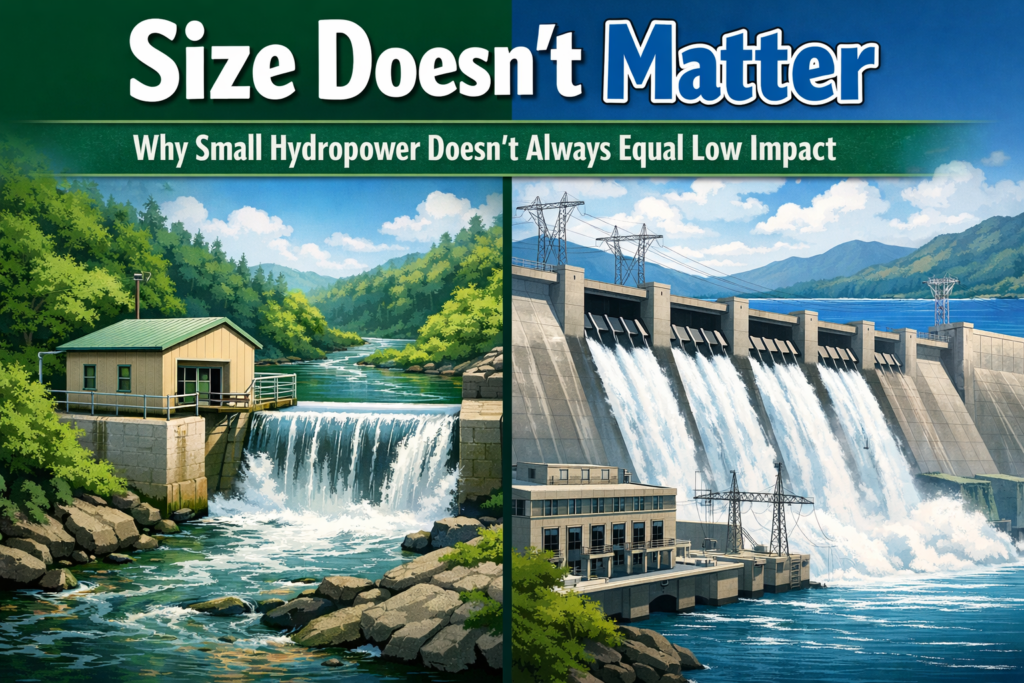
When people hear the phrase ‘low-impact hydropower,’ a funny thing happens, they often assume ‘low impact’ means small hydro.
It's a natural assumption—bigger reservoirs suggest dramatic changes to river systems and bigger problems. The mental image makes sense. Meanwhile, small facilities seem inherently gentler, more appropriate for a sustainable future.
It’s a misconception we hear often at the Low Impact Hydropower Institute (LIHI), which inspired a comprehensive analysis of 331 projects spanning 25 years. The in-depth report aims to answer the pressing question once and for all: Does the size of a project matter?
Well, the numbers are in, and most would be surprised that our findings tell a different story.
Are Only Small Hydropower Projects Eligible for Low Impact Certification?
The short answer: No. When applying the definition of low impact, size doesn’t predict impact. As Lydia Grimm, LIHI's first Executive Director, noted: "The underlying assumption that a 'small' project is necessarily less damaging than a 'large' project is not accurate."
Energy production alone does not define a project’s footprint. The most essential information is how a facility produces that energy and the environmental impacts it has on its surrounding community. A larger facility operating with protective flow regimes, effective fish passage, strong water quality protections, and robust stakeholder engagement can sometimes have fewer environmental impacts than a much smaller facility that disrupts critical habitat or river connectivity.
In turn, LIHI certification eligibility is not determined by facility size or capacity. Certified facilities range from very small projects (as low as 10 kW) to large projects with capacities up to 450 MW. Among LIHI’s certified facilities, 19.5% are smaller than 1 MW, while 4.2% exceed 100 MW.
LIHI evaluates every project, regardless of size, against the eight standardized and science-based criteria covering flow regimes, water quality, fish passage, watershed health, threatened and endangered species, cultural and historic resources, and public access.
When a facility of any size earns certification, it's because they've demonstrated genuine environmental stewardship.
Do Small Hydropower Projects Automatically Qualify for Certification?
Also no. In fact, among facilities that withdrew their certification applications based on the LIHI criteria, nearly 30% had a capacity of less than 1 MW. This is actually a higher percentage than that of certified facilities in the same size class. Meaning that almost one in three projects that didn’t complete the certification process were very small.
Beyond size and capacity, several factors may contribute to environmental impacts and determine whether a project meets the certification standards for low-impact hydropower, including:
Dam Height and Design: A facility's dam height correlates more closely with impact than its energy production capacity. Taller dams typically create larger reservoirs and may operate in store-and-release mode, affecting water levels, flow patterns, and downstream ecosystems. The analysis found that 36.4% of withdrawn facilities, compared with 22% of certified facilities, were located at dams 50 feet or taller.
Bypassed Reaches: When water is diverted from its natural channel—common in small run-of-river projects—the bypassed section of river can be left with insufficient flow to support aquatic life.
Operational Mode: Whether run-of-river or store-and-release(peaking), a facility's operations can significantly affect its environmental footprint. A small facility that diverts all streamflow away from the natural channel can cause severe habitat impacts, while a large facility that maintains natural flow patterns may have minimal effect on aquatic life.
Regulatory Framework: Facilities with older FERC licenses or exemptions—particularly those issued before 1986, when federal environmental protections were mandated—often have fewer built-in environmental safeguards. The median license year for withdrawn applications was 1984; for certified facilities, it was 1997. This isn't about the age of the facilities themselves, but whether environmental standards were considered during their licensing. On the other hand, 19% of withdrawn applications were for facilities with new licenses, proof that having a new license does not guarantee either a low environmental footprint, or certification.
Owner commitment makes all the difference.This might be the most important factor of all. Is the facility operator invested in environmental stewardship? Do they monitor impacts? Engage with stakeholders? Adapt practices based on new science? That commitment—or lack thereof—shows up regardless of facility size.
The Size-Based Policy Dilemma
The assumption that "small" equals "low impact" is one of the most persistent—and some may argue, problematic—myths in renewable energy policy.
Many state Renewable Portfolio Standards and renewable energy credit programs use megawatt thresholds—typically 10 MW or 30 MW—to define which facilities qualify as "low impact" or "small hydro." While these thresholds may appear clear and easy to administer, LIHI’s data suggests this approach could, unintentionally, have perverse consequences:
Rewarding facilities that may have significant environmental impacts simply because they fall below a capacity threshold, while excluding projects that have invested in environmental protection but exceed that limit. Twenty-five years of data have shown us what works: comprehensive criteria applied consistently, regardless of facility size.
As we work to expand renewable resources and clean energy production to meet climate goals, it's crucial that we define "low impact" accurately. Every facility should be evaluated on how well it protects river flows, water quality, fish populations, threatened species, cultural resources, and recreational access—not solely on how many megawatts it produces.
The path to truly sustainable energy production requires moving beyond baseline metrics to embrace nuanced, evidence-based standards.
It’s time policymakers consider whether performance-based standards might better serve environmental and energy goals than size limits.
The Renewable Energy Challenge
Hydropower provides reliable, renewable base load power that complements intermittent sources like wind and solar. At the same time, we need to protect rivers, fish populations, water quality, and the communities that depend on healthy watersheds. The good news is that these goals aren't mutually exclusive. The challenge—and opportunity—is in creating policies and programs that recognize and reward genuine environmental performance.
Every single LIHI Certification represents a facility operator who chose to invest in environmental stewardship, often beyond regulatory requirements, proving that low-impact hydropower is not about size—it’s about being responsible. In short, that means:
- Projects of any size can either meet or fail rigorous environmental standards,
- Operational choices often matter more than capacity, and
- Comprehensive, criteria-based evaluations are more effective than size limits.
That's the real story: Responsible hydropower operation is possible at any scale.
The question isn't "How big a project is?" but rather "How can we better protect the environment?" The adoption of comprehensive, outcome-based frameworks that avoid a one-size-fits-all definition and address actual environmental impacts are applicable to hydropower facilities of varying sizes. The adoption of this approach across the industry and in policy can help elevate the standard to better prioritize people and the environment.
Ready to Look Beyond Size? Click here to read the complete study, "Attributes that may (or may not) be Indicative of the Level of Hydropower Facility Ecological and Social Impacts: A LIHI Case Study."
You can also explore our certified facilities database to learn more about our projects and program standards.