Certificat LIHI #208 - Projet Chicopee Falls, Massachusetts
| Nom du projet | Chutes de Chicopee |
| Numéro de certificat LIHI |
208 |
| Durée du certificat LIHI |
12 février 2026 – 11 février 2036 |
| Propriétaire | Service d'éclairage électrique de Chicopee (exploité par Ware River Power Inc.) |
| État | Massachusetts |
| Emplacement | Mile 2,9 de la rivière Chicopee, comté de Hampden |
| Capacité installée | 2,5 MW |
| Génération annuelle moyenne | 8 850 MWh |
| Type d'établissement | Au fil de l'eau |
| Fédération internationale de radio-télévision (FERC) Non. | P-6522 exempté délivré le 8 décembre 1982 |
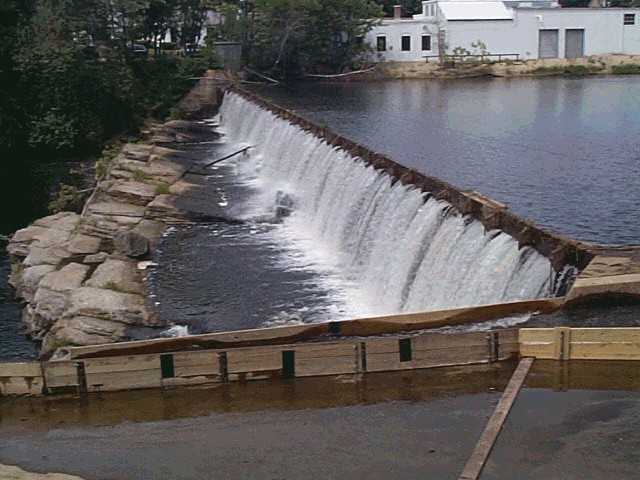
Le projet Chicopee Falls est situé dans la ville de Chicopee, dans le Massachusetts, et est le deuxième barrage Le barrage se situe sur la rivière Chicopee, en amont de son confluent avec le fleuve Connecticut. Bien que la rivière Chicopee ne mesure que 29 kilomètres de long, son bassin versant, d'une superficie de 1 870 kilomètres carrés, est le plus vaste du Massachusetts et le plus important bassin versant d'un affluent du fleuve Connecticut. Durant la révolution industrielle, la rivière Chicopee est devenue une destination particulièrement prisée pour la production d'hydroélectricité, notamment en raison de sa dénivellation de 79 mètres sur son cours. Le barrage a été construit en 1898 et la centrale hydroélectrique a été mise en service en 1985.
Il y a six centrales hydroélectriques sur le fleuve, dont Dwight (LIHI #170) situé à 2,7 kilomètres en aval. En remontant le courant depuis les chutes Chicopee, on trouve Verger indien (LIHI #112), Pont Putts (LIHI #102), Collins (LIHI #88), et Pont Rouge (LIHI #96).
Le projet consiste en un bloc de granit de 3 mètres de haut et de 78 mètres de long. barrage en maçonnerie avec un système hydraulique en bois de 1,4 pied de haut tableaux d'affichage; une structure de guérite, une structure de vanne sans déversoir, des murs de soutènement, un canal admission avec deux portes de tête; deux conduites forcées composé d'un caisson en béton de 7,3 mètres de large et de sections d'acier apparentes, chacune d'environ 27,4 mètres de long ; de prises d'eau avec grilles à déchets en acier espacées de 4,4 cm ; un centrale L'ouvrage comprend deux turbines bulbes ESAC d'une puissance de 1,25 MW chacune, ainsi que les installations annexes. Le barrage crée un réservoir d'une capacité de 310 acres-pieds et un tronçon de dérivation d'environ 500 pieds de long.
Le projet fonctionne de manière instantanée au fil de l'eau Un système de contrôle automatisé (PLC) et SCADA assure le maintien de niveaux de retenue stables et minimise les fluctuations. débit de base Un débit de 357 pieds cubes par seconde est prévu en aval du canal de fuite et un débit instantané minimal égal ou supérieur au débit d'étiage décennal de 127 pieds cubes par seconde est libéré au niveau du barrage dans la zone contournée pendant le fonctionnement de l'installation hydroélectrique pour la protection des ressources aquatiques et de la qualité de l'eau.
Les eaux situées dans la zone concernée par le projet sont classées comme pêcheries d'eau chaude de catégorie B. Elles sont également considérées comme dégradées en raison de la présence d'E. coli et de coliformes fécaux, probablement due à des conditions météorologiques humides combinées à des débordements d'égouts en amont du projet. La châtaigne d'eau, une espèce envahissante, est présente dans le bassin de retenue.
La seule espèce de poisson migrateur actuellement présente dans la rivière est l'anguille d'Amérique, observée en amont du projet, ce qui indique que certaines anguilles peuvent franchir naturellement le projet. Les espèces anadromes, notamment l'alose d'Amérique, la lamproie marine et le hareng de rivière, ainsi que de nombreuses anguilles d'Amérique, sont empêchées d'accéder au projet des chutes Chicopee par le barrage Dwight en aval, qui ne possède aucun dispositif de franchissement. passage des poissons Le bassin versant de la rivière Chicopee ne fait actuellement l'objet d'aucun programme de gestion des poissons migrateurs. Les espèces de poissons résidentes de la rivière Chicopee comprennent le barbotte noire, le crapet arlequin, la truite brune, la truite arc-en-ciel, le brochet maillé, le poisson-chat, la carpe, le méné, le crapet-soleil et l'achigan.
Le projet s'étend sur environ 6 acres de terre ferme et environ 4,4 acres sous l'eau. Il est situé dans une zone fortement urbanisée, malgré la présence d'étroites bandes végétalisées le long du rivage du bassin de retenue et sur la rive nord des tronçons déviés et en aval. Du fait de cette forte urbanisation, la zone du projet ne comprend aucun site présentant une valeur écologique significative. De plus, elle ne recèle aucun habitat essentiel pour les espèces menacées ou en voie de disparition.
Le Service américain de la pêche et de la faune sauvage (USFWS) indique que la chauve-souris tricolore, une espèce proposée pour inscription sur la liste des espèces menacées, pourrait être présente dans la zone du projet. Le papillon monarque, également menacé, pourrait aussi y être présent. Le projet étant situé en zone urbaine et ne nécessitant ni coupe d'arbres ni gestion importante de la végétation, il est peu probable que ces deux espèces soient affectées par les opérations. Le service de cartographie biologique du Massachusetts (Massachusetts Biomapper) indique qu'aucun habitat essentiel ni paysage naturel critique n'est présent à proximité immédiate du projet.
Il n'existe aucun site archéologique répertorié d'intérêt historique dans la zone de la centrale hydroélectrique de Chicopee, à l'exception du pont commémoratif Deady, qui permet à la route 33 (Memorial Drive) de franchir la rivière Chicopee à proximité du barrage, près de la maison des vannes. La région de Chicopee était habitée par des Amérindiens avant la colonisation européenne. Les tribus reconnues par le gouvernement fédéral sont la tribu Mashpee Wampanoag et la tribu Wampanoag de Gay. Tête (Aquinnah) du Massachusetts. La nation Nipmuc est une tribu reconnue par l'État.
La zone du projet présente un intérêt récréatif limité. La portion de rivière immédiatement en aval du barrage appartient à des entreprises privées, tandis que d'autres parties du terrain sont soumises à des restrictions pour des raisons de sécurité publique. Il existe des portages non liés au projet en amont et en aval, et il est probable que des accès informels pour la pêche soient également possibles.
État de conformité
Le certificat comprend la condition spécifique à l'établissement suivante :
Condition 1 : Dans le cadre des rapports annuels de conformité soumis à LIHI, le propriétaire/exploitant de l'installation doit fournir un résumé de toute consultation menée auprès des organismes compétents concernant le franchissement des obstacles à la migration des poissons en amont ou en aval. Si un organisme demande des études ou des installations de franchissement pendant la durée du contrat LIHI, un plan et un calendrier de mise en œuvre seront également fournis dans le ou les rapports de conformité concernés.
2026: Le rapport annuel pour le certificat actuel n'est pas encore entré en vigueur.
Historique des certifications
1er juillet 2026 : L’Institut de l’hydroélectricité à faible impact (LIHI) a rendu sa décision finale concernant la certification du projet hydroélectrique de Chicopee Falls (LIHI #208). Aucun recours n’a été reçu durant la période d’appel, qui s’est terminée le 26 juin 2026. La certification est valable pour une durée de 10 ans, du 12 février 2026 au 11 février 2036.
27 mai 2026 : L'Institut de l'hydroélectricité à faible impact (LIHI) a approuvé à titre préliminaire la certification à faible impact du projet hydroélectrique de Chicopee Falls (en attente LIHI #208), situé sur la rivière Chicopee dans le Massachusetts. Le dossier de demande complet et le rapport d'évaluation sont disponibles ci-dessous.
Cette décision est préliminaire, dans l'attente d'un délai d'appel de 30 jours. Seuls les candidats ayant commenté les demandes initiales pendant ce délai de 60 jours sont autorisés à déposer un recours. Ce recours doit inclure une explication expliquant en quoi le projet ne répond pas aux critères du LIHI. Les demandes de recours peuvent être soumises par courriel à l'adresse suivante : comments@lowimpacthydro.org Veuillez envoyer votre demande par courriel en indiquant “ Projet Chicopee Falls ” dans l’objet, ou par courrier à l’adresse suivante : Low Impact Hydropower Institute, 68 Harrison Ave Ste 605, PMB 113938 Boston, Massachusetts 02111-1929. Toutes les demandes seront publiées sur le site web. Le demandeur aura la possibilité de répondre et toute réponse sera également publiée. Les demandes doivent être reçues avant 17 h, heure de l'Est, le 26 juin 2026. Si aucune demande d'appel n'est reçue, la période de certification s'étendra du 12 février 2026 au 11 février 2036.
18 février 2026 L'Institut de l'hydroélectricité à faible impact (LIHI) a reçu un dossier complet de demande de certification à faible impact pour le projet hydroélectrique de Chicopee Falls. Le LIHI sollicite l'avis du public sur cette demande. Plus précisément, nous souhaitons savoir si vous estimez que le projet répond aux critères de certification à faible impact du LIHI, tels que révisés dans la 2e édition du manuel en vigueur au moment du dépôt de la demande. Veuillez consulter le programme et les critères dans le manuel du LIHI. Manuel Révision 2.06 Consultez ensuite les documents de candidature ci-dessous. Les commentaires directement liés aux critères spécifiques du LIHI (débits, qualité de l'eau, passage des poissons, etc.) seront les plus utiles, mais tous les commentaires seront pris en compte. Vous pouvez adresser vos commentaires à l'Institut par courriel à l'adresse suivante : comments@lowimpacthydro.org avec “ Commentaires sur le projet Chicopee Falls ” en objet, ou par courrier adressé au Low Impact Hydropower Institute, 68 Harrison Ave Ste 605, PMB 113938 Boston, Massachusetts 02111-1929. Les commentaires doivent être reçus au plus tard à 17 h, heure de l'Est, le 19 avril 2026. à prendre en considération. Tous les commentaires seront publiés sur le site Web et le candidat aura la possibilité d'y répondre. Toute réponse sera également publiée.
Dossiers de certification
Demande 2026
- Rapport d'évaluation des chutes de Chicopee
- Demande d'admission à Chicopee Falls
- Lettre de commentaires de l'USFWS
- Lettre de commentaires du MDFW