Solicitud pendiente - Proyecto de las cataratas de Chicopee, Massachusetts
| Nombre del proyecto | Cataratas de Chicopee |
| Certificado LIHI No. |
n / A |
| Plazo del certificado LIHI |
n / A |
| Dueño | Departamento de luz eléctrica de Chicopee (operado por Ware River Power Inc.) |
| Estado | Massachusetts |
| Ubicación | Milla fluvial 2,9 en el río Chicopee, condado de Hampden |
| Capacidad instalada | 2,5 MW |
| Generación media anual | 8.850 MWh |
| Tipo de instalación | De pasada |
| Comisión Federal de Comercio No. | P-6522 exento emitido el 8 de diciembre de 1982 |
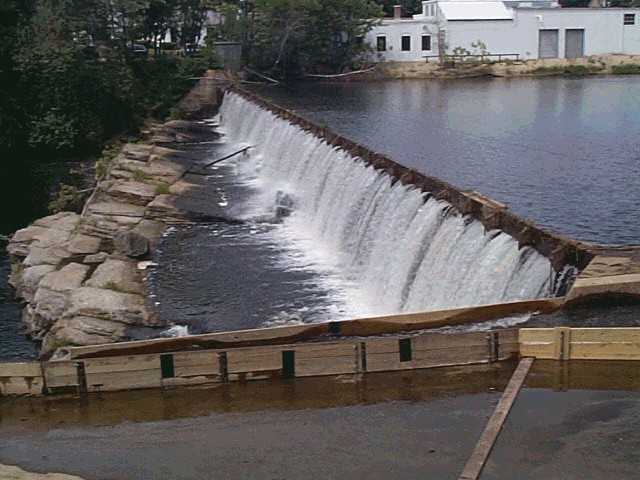
El Proyecto Chicopee Falls está ubicado en la ciudad de Chicopee MA y es el segundo presa En el río Chicopee, sobre su confluencia con el río Connecticut. Aunque el río Chicopee tiene solo 29 kilómetros de longitud, su cuenca hidrográfica es de 1837 kilómetros cuadrados, la más extensa de todo Massachusetts y la mayor cuenca afluente del río Connecticut. Durante la Revolución Industrial, el río Chicopee se convirtió en un destino especialmente codiciado para la energía hidroeléctrica, en gran parte debido a su caída de 79 metros en su curso. La presa se construyó originalmente en 1898 y las operaciones hidroeléctricas comenzaron en 1985.
Hay seis instalaciones hidroeléctricas en el río, incluidas Dwight (LIHI-#170) Ubicado a 1,7 millas río abajo. Río arriba desde las cataratas de Chicopee se encuentran Huerto indio (LIHI #112), Puente de putts (LIHI #102), Collins (LIHI-#88), y Puente rojo (LIHI #96).
El proyecto consiste en un bloque de granito de 10 pies de alto y 256 pies de largo. presa de mampostería con hidráulico de madera de 1,4 pies de altura tableros de flash; una estructura de puerta de entrada, una estructura de compuerta antidesbordamiento, muros de contención, una canal admisión con dos compuertas de entrada; dos tuberías forzadas que consta de una caja de hormigón de 24 pies de ancho y secciones de acero expuestas, cada una de aproximadamente 90 pies de largo; entradas con rejillas de acero para basura con un espaciamiento de 1-3/4”; una central eléctrica Contiene dos turbinas bulbo ESAC: la Turbina 1 es una unidad de 1700 kW con una capacidad hidráulica de 1050 pies cúbicos por segundo (cfs) y la Turbina 2 es una unidad de 800 kW con una capacidad hidráulica de 500 cfs; además de las instalaciones auxiliares. La presa crea un embalse con una capacidad de almacenamiento de 310 acres-pies y un tramo desviado de aproximadamente 500 pies de longitud.
El proyecto opera de forma instantánea. de pasada Modo monitoreado por un PLC y un sistema SCADA para mantener estables los niveles del embalse y minimizar las fluctuaciones. Un sistema acuático flujo base Se proporciona un caudal de 357 pies cúbicos por segundo por debajo del canal de descarga y se libera un caudal instantáneo mínimo igual o superior al caudal más bajo de 7 días y 10 años de 127 pies cúbicos por segundo en la presa hacia el tramo desviado durante la operación de la instalación hidroeléctrica para la protección de los recursos acuáticos y la calidad del agua.
Las aguas dentro del alcance del proyecto están designadas como pesquerías de aguas cálidas de clase B. También se consideran contaminadas por E. coli y coliformes fecales, aunque la causa probable de este deterioro es el clima húmedo combinado con desbordamientos de alcantarillado aguas arriba del proyecto. En el embalse se encuentra la castaña de agua invasora.
La única especie de pez migratorio presente actualmente en el río es la anguila americana, que se ha observado aguas arriba del proyecto, lo que indica que algunas anguilas pueden pasar naturalmente por el mismo. Las especies anádromas, como el sábalo americano, la lamprea marina y el arenque de río, así como muchas anguilas americanas, tienen bloqueado el acceso al Proyecto de las Cataratas Chicopee por la presa Dwight, aguas abajo, que no tiene ningún... paso de peces Requisitos. La cuenca del río Chicopee no está actualmente sujeta a medidas de gestión de peces migratorios. Las especies de peces residentes en el río Chicopee incluyen el pez gato negro, el pez sol, la trucha marrón, la trucha arcoíris, el lucio, el bagre de canal, la carpa, el pez alburno, el pez luna y la lubina.
Los terrenos del proyecto abarcan aproximadamente 6 acres de tierra y aproximadamente 4,4 acres bajo el agua. El proyecto se ubica en una zona altamente urbanizada, aunque existen estrechas zonas de amortiguamiento con vegetación a lo largo de la costa del embalse y en el lado norte de los tramos desviados y aguas abajo. Debido a la alta urbanización de la zona, no existen tierras de valor ecológico significativo en el área del proyecto. Además, no existen hábitats críticos para ninguna especie en peligro de extinción o amenazada.
El Servicio de Pesca y Vida Silvestre de los Estados Unidos (USFWS) indica que el murciélago tricolor, especie propuesta para su inclusión en la lista de especies en peligro de extinción, podría estar presente en el área del proyecto. La mariposa monarca, considerada amenazada, también podría estar presente. Dado que el proyecto se ubica en una zona urbana y no requiere la tala de árboles ni un manejo significativo de la vegetación, es probable que ninguna de estas especies se vea afectada por las operaciones del proyecto. El Biomapeador de Massachusetts indica que no existen hábitats centrales ni paisajes naturales críticos en las inmediaciones del proyecto.
No existen sitios arqueológicos catalogados de valor histórico en la zona de la central hidroeléctrica de Chicopee, excepto el puente Deady Memorial, que lleva la Ruta 33 (Memorial Drive) sobre el río Chicopee, junto a la presa, cerca de la caseta de vigilancia. La zona de Chicopee fue el hogar de los nativos americanos antes de la llegada de los europeos. Las tribus reconocidas a nivel federal son la tribu mashpee wampanoag y la tribu wampanoag de Gay. Cabeza (Aquinnah) de Massachusetts. La Nación Nipmuc es una tribu reconocida por el estado.
El área del proyecto tiene un valor recreativo limitado. El tramo del río inmediatamente debajo de la presa es propiedad de empresas privadas, mientras que otras partes de la propiedad están restringidas por razones de seguridad pública. Existen porteos no pertenecientes al proyecto río arriba y río abajo, y es probable que también exista acceso informal para la pesca.
Historial de certificaciones
18 de febrero de 2026 El Instituto de Energía Hidroeléctrica de Bajo Impacto (LIHI) ha recibido una solicitud completa para la Certificación de Bajo Impacto del Proyecto Hidroeléctrico Chicopee Falls. LIHI solicita comentarios públicos sobre esta solicitud. En concreto, nos interesa saber si considera que el Proyecto cumple con los Criterios de Certificación de Bajo Impacto de LIHI, revisados en la 2.ª edición del Manual vigente al momento de la solicitud inicial. Por favor, revise el programa y los criterios en el sitio web de LIHI. Revisión del manual 2.06 y luego revise los materiales de solicitud del Proyecto a continuación.
Los comentarios que estén directamente relacionados con criterios específicos del LIHI (caudales, calidad del agua, paso de peces, etc.) serán de gran ayuda, pero se tendrán en cuenta todos los comentarios. Los comentarios pueden enviarse al Instituto por correo electrónico a comments@lowimpacthydro.org con “Comentarios del Proyecto Chicopee Falls” en la línea de asunto, o por correo dirigido al Low Impact Hydropower Institute, 68 Harrison Ave Ste 605, PMB 113938 Boston, Massachusetts 02111-1929. Los comentarios deben recibirse antes de las 5 p. m., hora del Este, el 19 de abril de 2026. Se considerarán todos los comentarios. Se publicarán en el sitio web y el solicitante tendrá la oportunidad de responder. También se publicarán todas las respuestas.
Archivos de certificación
Solicitud 2026
- Solicitud de Chicopee Falls
- Anexo A de la solicitud
- Anexo B de la solicitud
- Anexo C de la solicitud
- Anexo D de la solicitud